
So you have taken the big step and purchased a Native American Flute. I want clarify a point here that I feel is very important. If the maker of the flute is not Native American, the flute you bought is a Native American Style Flute. If it is sold as a Native American Flute, Federal Law mandates its maker must be a Native American. Everybody else needs to sell Native American Style flutes.
Due to bandwidth issues with my ISP, I have opted to use text and audio files to present this information. I may at certain points where I feel it is needed to clearly illustrate something, provide a video. I welcome any questions and/or comments. Due to SPAM which produces many, many false comments that must be manually screened, I may miss a comment that should be posted. Same goes for subscriptions so if you comment, post a question or subscribe and you don’t see actions on my part, you may email me at harold@brokensky.biz and let me know who you are so I can clearly see that your request is valid. It would be a good idea if you subscribe to this blog, to drop me a short line when you subscribe. I check email many times every day and I will login and approve your subscription within the day if you do so. I apologize for any inconvenience, but even with filtering, it can be a huge task dealing with SPAM.
Now that I’ve said all that, let us begin to unlock all those beautiful sounds of the flute you just purchased. I will try to keep the technical and music theory to a minimum for the sake of those like me that do not site read. I know enough music theory to communicate with other musicians, but I am not fluent in the written language nor can I tell you the names of all the chords I play on a guitar or keyboard.
The Native American Flute (NAF), uses a minor pentatonic scale. It is melodic, but as it is a minor scale can have a beautifully haunting feel or mood to it. Here is a chart showing the extended scale on NAF. The red dots indicate the notes that are the pentanonic scale and do not require cross fingering. My understanding of the term cross fingering is playing a note that has a hole closed below a hole that is open. Below meaning lower in pitch or physically closer to the foot end of the flute.
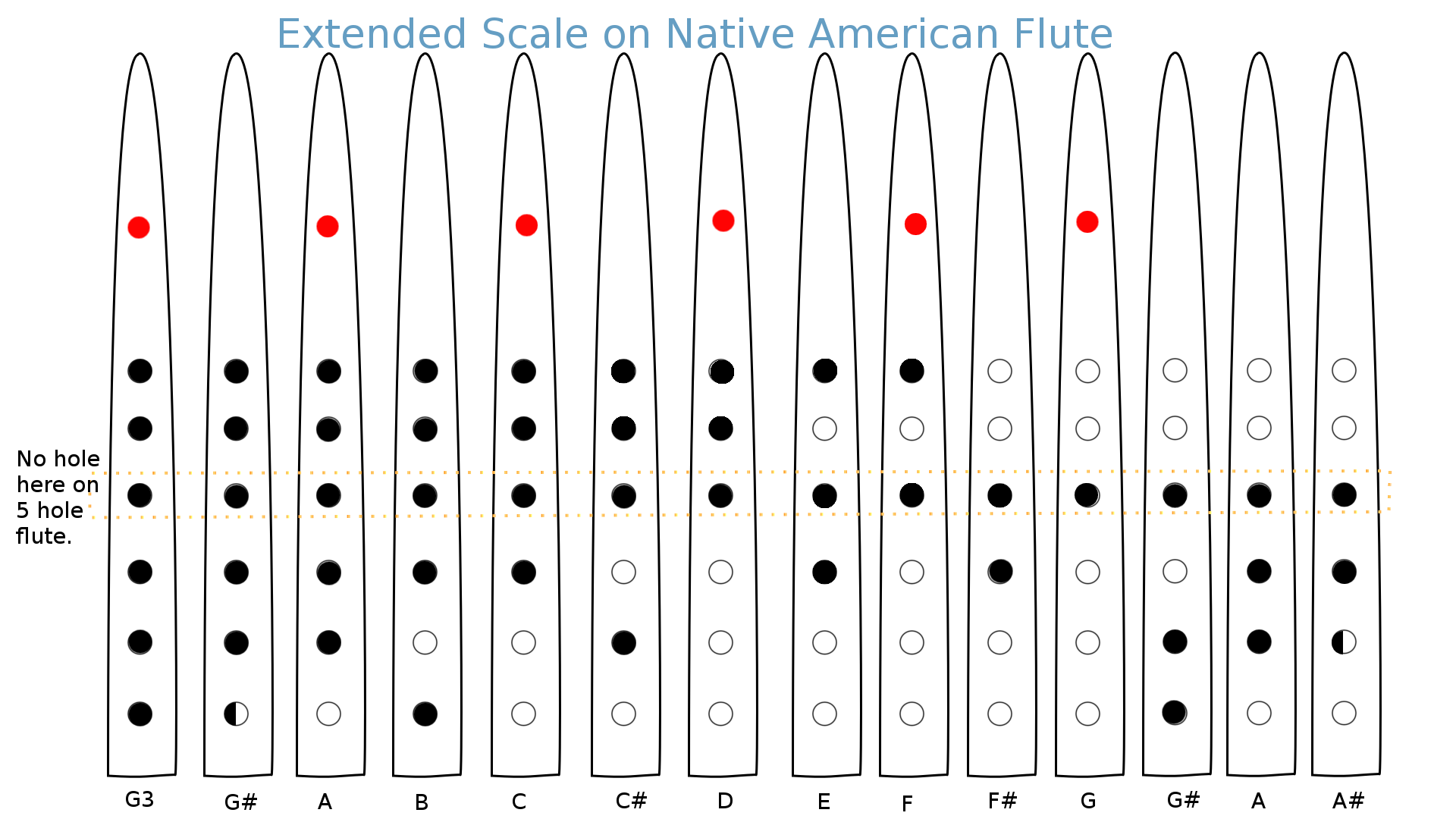
To begin playing the flute, press your lips to the opening on the mouth end of the flute. Don’t put your mouth over the end, but press your lips to it. You don’t need to make an embouchure like rim blown or cross blown flutes. The TSH and block are taking care of that. Blow or more correctly breathe into the flute. I will use the terms blow and breathe interchangeably. Create only enough pressure to create the tone. Try this with no holes covered first. If you blow too hard it will cause an octave jump or maybe a squeaking sound. Once you have a nice sounding tone, you are ready to start covering the holes.
I would suggest starting with hole 5 as it gives you only one hole to concentrate on. For the sake of ease of communication. I make and play 5 hole flutes. I own a six hole, but I never open the “extra” hole. Every note possible on a 6 hole flute can be played on a 5 hole flute. I will assume in these lessons that hole #4 from the bottom of a 6 hole flute is never opened and not there. So the holes will be numbered 1, 2, 3, 4 & 5 counting from the foot end of the flute (the foot end being away from the mouth). Once you can play a nice clear note on hole 5, then cover both holes 5 and 4. Continue that process until you can produce clear notes on all the holes of the flute. If you hear a squeaking sort of sound, it is likely a hole is not covered well. Which one? If you have more than one hole covered it is difficult to know. Start with hole 5 and adjust your finger to ensure the hole is fully covered. Do this for each finger until the squeak stops.
When you cover a hole, use the soft pad of your finger. You can get by with using the tip of your finger, but it is often more difficult. Using the soft pad of the finger also makes for more comfort as you hold the flute because it is a more natural position for your hands. I don’t see any value in playing the notes for you as a sample at this point. If you have ever listened to a flute song, you know what a nice tone sounds like.
When you can play all of the holes of the flute and produce nice clear notes, you are ready to move to the next “level” for want of a better word.
Proceed to lesson two: How to play the minor pentatonic scale and note expression.